• Featured
  • Australasia
  • The Americas
  • Europe
  • Africa
  • Market
  • Precious Metals
  • Resources
  • Currencies
  • Real Estate
  • The Bonner Diaries

Good News and Bad News: Inflation in the Housing Markets


By Bill Bonner • February 28th, 2008 • Related Articles • Filed Under

About the Author

Bill BonnerBest-selling investment author Bill Bonner is the founder and president of Agora Publishing, one of the world's most successful consumer newsletter companies. Owner of both Fleet Street Publications and MoneyWeek magazine in the UK, he is also author of the free daily e-mail The Daily Reckoning.

See All Articles by This Author

  • None Found
Filed Under: Market
Tags: good news and bad news • housing market • inflation

The news is both good and bad, depending on how you look at it.

As to the good news, the Dow rose 114 points yesterday and long bonds have been going down. They may be looking ahead to growth and prosperity... or just to inflation. We don't know. Yields on long-dated Treasury bonds, for example, have been going up (which is what happens when prices go down). Curiously, or perhaps tellingly, they have been rising even as the Fed lowers short-term rates.

The feds are trying to keep the party going, of course, by refilling the punch bowl as fast as they can. The U.S. money supply is increasing about five times faster than the economy itself. Even this breakneck speed is merely trotting compared to money growth in some places. In Russia and China, for example, money supply growth is said to be multiples of the U.S. rate.

Our hypothesis is that this inflation will affect commodity, gold and consumer prices more than it boosts prices for stocks and property. We don't know how the party will end, in other words. But if it just poops out into deflation, the big losers are going to be stock and property holders. Prices will collapse. On the other hand, if it burns out with higher and higher inflation rates, we judge it most likely that the highest prices will be realized in the oil, gold and commodity markets... not in the stock market. That is why we think gold is a better bet than stocks.

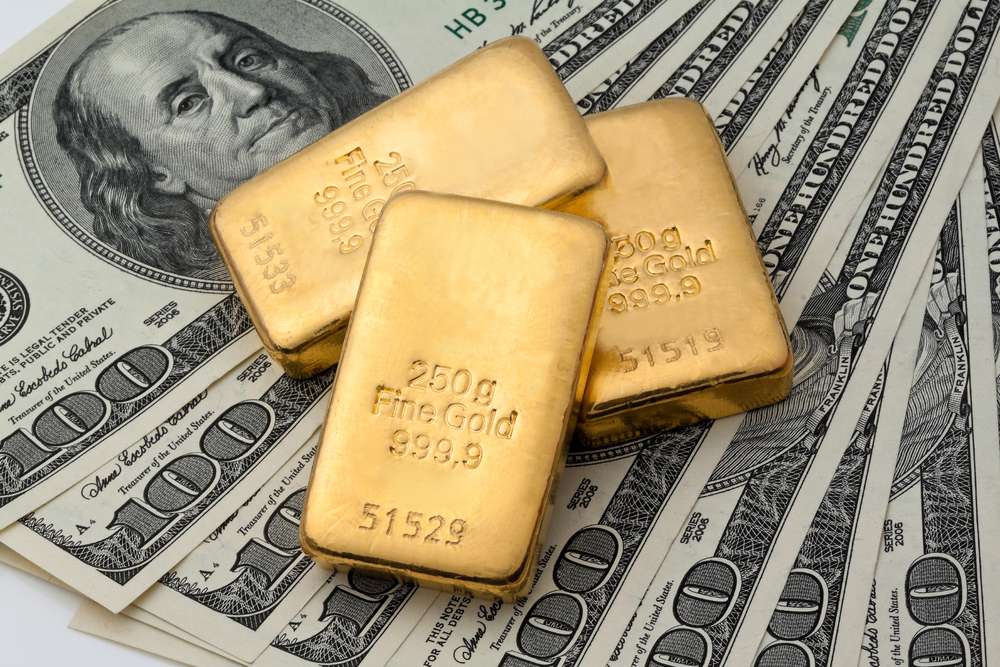
Yesterday, gold hit $948. It will probably go to $1,000 soon. And then to $2,000.

The U.S. dollar weakened further, yesterday, hitting an all-time low against the euro at $1.49/euro. A couple of years ago, we predicted that the buck would sink to $1.50/euro. With less than a penny to go, it's probably time to think again. Stay tuned.

In the meantime, oil also hit a new record high yesterday - closing at $100.88.

All of this may be considered "good" news - in the sense that it signals a growing inflation threat... and maybe even a growing world economy.

The bad news is that inflation raises consumer prices - at the very time when U.S. consumers have less to spend.

Most of yesterday's 'bad' news came from the U.S. property sector . But even there all the latest headlines were not depressing. It turns out that much of the United States is actually experiencing rising housing prices. Trouble is, it's not the part that people live in.

Leading the nation is West Virginia, believe it or not, where house prices went up 19% last year. Even so, the median house in the mountain state sold for only $116,000. Robert Shiller, who is an expert on housing price trends, says the "back country cities" just never got into the "bubble picture." They're still good buys.

Daily Reckoning readers might want to consider a trade: sell California, buy West Virginia. We like West Virginia, and can imagine ourselves living happily there. But most people find it a bit backward and depressing. Here in London, prices are so high that $116,000 would barely buy a parking space. Even a tiny row house in London... with only two bedrooms... and barely 1,200 square feet of space... in a modest part of town, well away from the center, is on offer for $1.7 million. People here can't imagine being able to buy a whole house for $116,000. Then again, they've never been to West Virginia.

But in the rest of the nation, the housing picture is not so pretty.

"Foreclosures up 90% as mortgages reset," says a Bloomberg headline. The Case-Shiller Index revealed that the housing crisis is deepening. In the last quarter of '07, prices of existing single-family houses fell 5.4%... up from a decline of barely 1% in the first quarter. Year to year, prices fell 8.9% in the fourth quarter of '07... speeding up to 9.1% in the month of December.

California does everything to excess - even a housing decline. In the Golden State, house sales fell 29.8% in January (from the preceding year), with prices down 21.9%.

A government housing index, meanwhile, puts prices nationwide down at the steepest rate in 17 years.

"Housing in freefall until credit loosens," summarizes the International Herald Tribune .

Naturally, this puts consumers in a bad mood. Consumer confidence is at a five-year low... and headed down.

Housing is the average man's major asset. When it goes down, he takes it hard.

*** Americans have only three major sources of wealth, we pointed out yesterday. The "wealthy" have stocks - often in pension plans. The average fellow has a house - often heavily burdened with mortgage debt. And they all have the value of their own time.

When housing prices go down, it hits Americans' #1 source of wealth. They've got about $20 trillion worth of houses. If house prices went down 9% last year, it represents a loss of 'implied' wealth of $1.8 trillion. We say 'implied' because the wealth was largely phony in the first place. A house is a house. It provides service, but it doesn't provide any more service if it is quoted at $500,000 than if it is quoted at $300,000. Same roof. Same air-conditioning. Same everything. Except, when it is said to be worth more, two noxious things result. First, the homeowner can "take out" some of the equity and feel like he is still ahead of the game. He doesn't worry about it when prices are rising; when the loan comes due, he can always take out a little more. Gradually, he gets deeper and deeper into debt. And then, inevitably, his house goes down in price and he's in trouble.

The other awful consequence is that the cost of owning the house goes up. As the house becomes more "valuable," typically the costs of property taxes, insurance and upkeep mount. Thus, the net value, or net service, an owner gets from his house actually goes down. He has the same roof over his head, but it costs him more.

That is the trouble with inflation - even inflation in the housing markets. Ceteris paribus, inflation reduces the real value of both assets and time. Most Americans no longer have much in the way of assets. The big, post-Reagan boom, 1982-2007, discouraged saving. If people had equity in their houses, they tended to spend it. And the real value of stocks has gone down over the last decade. That leaves the nation of capitalists dependent on its own labour. The average man in American has no capital to work with... he only has his hands and his brain, such as it is.

Most Americans have to work; they depend on their earnings to live. Without the income from their labour, they'd be destitute in a matter of weeks.

But inflation reduces the value of wages. The gold-linked dollar was never a perfectly stable currency. It went up and down. But the dollar of 1930 was still worth about as much as the dollar from Washington's era. Then, the link with gold was weakened; between ' 30 and ' 71, the greenback lost about 70% of its value. After 1971, there was no link to gold at all and the dollar fell even faster. If a dollar was worth 100 cents in 1930, by 1971 it was worth only 30 cents... and by 2007... only about 5 cents.

The decline of the dollar, along with the competition from low-cost Asian labourers, is why Americans have had no real wage increases in 30 years. For every gain they make, the dollar goes down in value to offset it. In the last 6 years alone, the dollar has lost 36% of its value - as measured against other currencies. Shops in New York are beginning to take euros, reports the Washington Post.

Of course, inflation can be useful. Asian wages are rising about 10% per year. U.S. wages are falling. Americans will never consent to pay cuts in order to make their own labour competitive with Asians. Inflation will make the cuts for them.

Bill Bonner
The Daily Reckoning Australia

VN:F [1.9.11_1134]
please wait...
Rating: 0.0/10 (0 votes cast)
VN:F [1.9.11_1134]
Rating: 0 (from 0 votes)


P.S. to get The Daily Reckoning direct to your inbox sign up to our free e-mail newsletter or if you prefer to use RSS, subscribe to the Daily Reckoning RSS feed.

Related Articles:

  • None Found

About the Author

Bill BonnerBest-selling investment author Bill Bonner is the founder and president of Agora Publishing, one of the world's most successful consumer newsletter companies. Owner of both Fleet Street Publications and MoneyWeek magazine in the UK, he is also author of the free daily e-mail The Daily Reckoning.

See All Posts by This Author

There Are 2 Responses So Far. »

  1. Comment by justin on 28 February 2008:

    A question,

    if the devaluation of the dollar is causing inflation in the stockmarket, does this mean that as the dollar continues to slide the stockmarket will continue to rise, when priced in dollars?

    i.e. there won't be any sudden catastrophic fall?

    VA:F [1.9.11_1134]
    please wait...
    Rating: 0.0/5 (0 votes cast)
    VA:F [1.9.11_1134]
    Rating: 0 (from 0 votes)
  2. Comment by John on 29 February 2008:

    Justin,

    Yes, cetarus paribus. But stock prices are determined by much more than just the value of the dollar (economic outlook, interest rates, volatility, earnings, etc...) so it is hard to say whether the net effect of everything put together will put them up or down.

    But if you were to price the stock market in terms of gold (real money), it is actually going down over the past several years.

    VA:F [1.9.11_1134]
    please wait...
    Rating: 0.0/5 (0 votes cast)
    VA:F [1.9.11_1134]
    Rating: 0 (from 0 votes)

Post a Response

Comment moderation policy: Port Phillip Publishing supports free speech and frank and open conversation. But we reserve the right to modify or delete your comments if we consider them to be offensive or in violation of any laws, including Australia's anti-discrimination laws

By submitting your comment you agree to adhere to our comment policy.


  • Why Should I Sign Up?   We Value Your Privacy
  • Master trader predicts next move for ASX...

    Latest Slipstream Trader Video Market Update Just In... watch for free below.


    One viewer said these prediction videos were “scarily accurate”... another said Murray Dawes was “well on the money”... To find out where the Slipstream Trader thinks the market is headed next, and what that could mean for your investments, click below now to watch his latest video update...

    8th February 2012 - Market Update

    It’s one thing to have a view on where the market is headed next... It’s another to have specific stock trading recommendations emailed to your inbox.

    To take a 90-day, no obligation trial of Slipstream Trader, click here
  • Search

    The Markets

    All Ordinaries4359.400  chart0.000
    S&p/asx 2004285.100  chart0.000
    China Shanghai Co2351.854  chart-0.126
    Gold Sep 110.00  chart0.00
    Clj11.nym0.00  chartN/A
    Nikkei 2258999.18  chart0
    Indu0.00  chartN/A
    S&P 5001351.77  chart+9.13
    Ftse 1005905.70  chart+53.31
    2012-02-13 00:35

    Most Comments

    • Australian House Prices Are Severely and Seriously Unaffordable (312)
    • Majority of Australians Believe House Prices Will Rise in Next Twelve Months (293)
    • Gas is the New Oil (256)
    • A Date for an Aussie House Price Collapse (251)
    • How to Profit From the Path of Progress (230)

    Archives

  • Headline Archive

  • Slipstream Trader

    Thousands now trade the markets who never thought they could...

    Breakthrough in trading techniques helps regular investors:

    • Determine how much to risk in a trade
    • Lock in profits while the position is still open...
    • Exit a losing position before a share tanks...

    If you thought trading was too complicated, prepare to be surprised... click here
  • Australian Wealth Gameplan

    "A rapid contagion is spreading.
    Even if you think you are relatively safe, this is a new, permanent risk. It will be with us for the next decade, or even two”.

    - Edward Morse, Veteran oil trader

    Right now a ‘paradigm shift’ is taking place that could present you with the single biggest investment opportunity of your lifetime.

    It also represents risks to your portfolio that could surpass those of the Global Financial Crisis fallout.

    Get full details in this just-completed presentation. (turn on your speakers)
  • Diggers & Drillers

    “Why a mining executive told me to F*** Off
    in front of a whole room of investors”
    Dr. Alex Cowie doesn’t have the most popular of jobs. At least – not inside the mining industry. For his readers, it’s another matter entirely.

    As Laurence says: “I have never bought a stock and got a 100% return before … thanks for providing the information for me to have that experience – and all within two months too!”

    Right now Alex has unearthed six “must buy” resource stocks for the year ahead. His method for finding them might annoy a few people in the industry… but it could help make a lot of money in 2012 too.

    Find out why, right here

  • Home
  • Newsletters
  • About
  • Subscribe
  • Columnists
  • Contact Us
  • RSS

All content is © 2005 - 2011 Port Phillip Publishing Pty Ltd All Rights Reserved

We encourage you to republish our material, all we ask is that you provide a working text link back to the original article on this site.
Port Phillip Publishing Pty Ltd holds an Australian Financial Services License: 323 988. ACN: 117 765 009 ABN: 33 117 765 009
email: dr@dailyreckoning.com.au Tel: 1300 667 481 Fax: (03) 9558 2219
Port Phillip Publishing Attn: The Daily Reckoning PO Box 899 Braeside VIC 3195

Terms and Conditions | Privacy Policy | Financial Services Guide

SEO Powered by Platinum SEO from Techblissonline